
Maha Mrityunjaya Jaap
Our Popular Puja & Anushthan
Get in Touch
For Puja bookings, temple visits, accommodation arrangements, or any other information, please feel free to contact us. Contact us today to get more information about your Puja or temple visit.
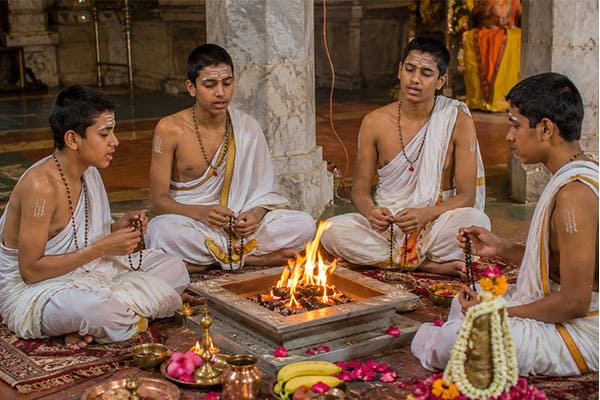
A Traditional Shiva Anushthan for Devotion, Peace and Spiritual Strength
Maha Mrityunjaya Jaap is a revered Vedic practice dedicated to Lord Shiva in His Tryambaka form. The Maha Mrityunjaya Mantra is found in the Rigveda (7.59.12) and is traditionally recited as a prayer to Lord Shiva for peace, spiritual strength and freedom from the fear of death.
The mantra is traditionally known as the Tryambaka Mantra or Mrityunjaya Mantra:
Om Tryambakam Yajamahe Sugandhim Pushtivardhanam
Urvarukamiva Bandhanan Mrityor Mukshiya Maamritat.
In traditional Hindu practice, devotees undertake Maha Mrityunjaya Mantra Jaap with faith and devotion, particularly when seeking divine blessings, inner strength, peace and well-being.
At Rahu Mandir Paithani, the Anushthan is conducted by the Gurukul’s Acharyas, teachers and Brahmachari Batuks under proper guidance and according to traditional religious practices.
The ceremony is a devotional offering to Lord Shiva. It should not be understood as a guarantee of any particular health, financial or material outcome.
What Happens During Maha Mrityunjaya Jaap?
A complete Maha Mrityunjaya Anushthan can involve several stages rather than only the chanting of the main Mantra.
Depending on the Sankalp and selected form of the Anushthan, the ceremony may include:
- Ganesh Puja
- Sankalp
- Kalash Sthapana
- Invocation of the deities
- Shiva Puja
- Shiva Abhishek
- Maha Mrityunjaya Mantra Jaap
- Shiva Stotra and prayer recitation
- Havan
- Purnahuti
- Aarti
- Final Abhishek
- Prasad
The exact Jaap count and supporting rituals may vary according to the Yajman’s Sankalp and the guidance of the Acharyas.
Maha Mrityunjaya Jaap Vidhi
1. Preparing the Anushthan
The designated Puja area is first cleaned and arranged for the ceremony.
The required arrangements are made for the Shiva Puja, Kalash, Puja Vedi, Mantra Jaap and Havan.
Since an extended Jaap can take several hours, adequate seating is also arranged for the participating Acharyas and Brahmachari Batuks.
2. Ganesh Puja
The religious ceremony begins with the worship of Lord Ganesha.
Prayers are offered for the successful completion of the Anushthan and for the removal of obstacles during the Puja.
3. Yajman’s Sankalp
The Yajman then takes a formal Sankalp for the Anushthan.
The Sankalp may include the Yajman’s name, Gotra, date of birth and other relevant details.
The specific devotional purpose for undertaking the Maha Mrityunjaya Jaap may also be included.
4. Kalash Sthapana
Kalash Sthapana and the invocation of the relevant deities are performed according to the selected traditional procedure.
After these preliminary rituals, the principal Shiva worship begins.
5. Shiva Puja
The central focus of the ceremony is the worship of Lord Shiva.
The Shiva Lingam or designated form of Shiva is worshipped according to the prescribed Puja procedure.
Flowers, Bilva Patra, Chandan, Akshat, Dhoop, Deep, Naivedya and other appropriate Puja materials may be offered according to the tradition being followed.
6. Shiva Abhishek
A Shiva Abhishek may be performed as part of the Anushthan.
Water and other prescribed materials may be offered while prayers are recited in devotion to Lord Shiva.
The Abhishek is performed as an expression of श्रद्धा and prayer for peace, auspiciousness and divine grace.
7. Maha Mrityunjaya Mantra Jaap
The central part of the ceremony is the Maha Mrityunjaya Mantra Jaap.
The Mantra is recited by the Acharyas and Brahmachari Batuks with attention to proper pronunciation, discipline and devotional practice.
The number of repetitions is not necessarily identical for every Anushthan. It may be determined according to the Yajman’s Sankalp and the guidance of the Acharyas.
A traditional Mala generally consists of 108 repetitions, while extended Anushthans may involve substantially more recitations.
8. Shiva Stotra and Supporting Prayers
Depending on the selected Anushthan, additional Shiva Mantras, Stotras and Vedic prayers may also be recited.
These supporting prayers complement the main Mantra Jaap and provide an opportunity for the Yajman and participating devotees to express their devotion to Lord Shiva.
9. Maha Mrityunjaya Havan
An extended Maha Mrityunjaya Anushthan may include a Havan.
A sacred fire is established and offerings are made while the prescribed Mantras are recited.
The Havan is conducted under the supervision and guidance of the Acharyas.
10. Purnahuti
Once the prescribed Havan procedure is completed, Purnahuti is offered.
This marks the completion of the principal fire ritual.
The Acharyas then offer concluding prayers for the Yajman and their family.
11. Aarti and Final Prayer
The Anushthan proceeds towards its concluding stage with Aarti and prayer.
Prayers are offered for peace, wisdom, courage, spiritual strength and divine blessings.
12. Final Abhishek and Prasad
The final religious procedures are completed after the principal Jaap and Havan.
The final Abhishek after completion of the Maha Mrityunjaya Jaap will be performed at Rahu Mandir Paithani itself.
The concluding prayer and Aarti are followed by Prasad for the Yajman.
Who Performs Maha Mrityunjaya Jaap?
At Rahu Mandir Paithani, the Maha Mrityunjaya Jaap is performed by the Gurukul’s Acharyas, teachers and Brahmachari Batuks.
The Brahmachari Batuks study Sanskrit, Vedic knowledge, Karmakanda, Mantra recitation and traditional religious practices as part of their Gurukul education.
The Jaap and associated Puja are conducted under the guidance of the Acharyas with sincerity, discipline and devotion.
Depending on the nature of the Anushthan, the Yajman may participate in the Sankalp, Abhishek or other designated parts of the Puja.
How Does the Maha Mrityunjaya Jaap Begin?
Before confirming the Anushthan, the necessary details of the Yajman may be collected.
These may include:
- Full Name
- Gotra
- Date of Birth
- Relevant birth details
- Contact information
- Purpose of the Jaap
- Preferred date
- Birth Kundli, if available
Once the arrangements have been confirmed, the Puja area is prepared and the religious ceremony begins.
Opening Sequence
Puja Preparation → Ganesh Puja → Sankalp → Kalash Sthapana → Devata Invocation → Shiva Puja → Abhishek → Maha Mrityunjaya Mantra Jaap
The ceremony then continues with supporting prayers, Havan and the prescribed concluding rituals.
How Is Maha Mrityunjaya Jaap Completed?
After the prescribed number of Mantra recitations and supporting religious procedures have been completed, the Anushthan moves towards its concluding stage.
The final sequence may include:
Maha Mrityunjaya Jaap → Shiva Stotra → Havan → Purnahuti → Final Abhishek → Aarti → Prayer → Prasad
The final Abhishek will be performed at Rahu Mandir Paithani.
The ceremony concludes with prayers to Lord Shiva for peace, strength, wisdom, spiritual well-being and divine grace.
Choosing the Right Place for Puja
To perform the puja according to Vedic rituals and traditions, enough space is required. Proper arrangements are needed for Ganesh Puja, Kalash Sthapana, the puja altar, and Bhadra. Adequate space is also necessary for the Batuk Brahmacharis and Acharyas who participate in the chanting of mantras and other religious rituals.
The main puja area at Rahu Temple does not have enough space for all these arrangements. Regular puja, darshan, and other religious activities also continue at the temple. Therefore, performing a detailed puja ceremony at the main temple area for several hours is not practical.
Puja at a Place Near the Temple
If the Yajman (devotee) wishes to perform the puja near Rahu Temple, they will need to arrange a suitable place on rent.
The rented place will have enough space for Ganesh Puja, Kalash Sthapana, Bhadra preparation, Sankalp, mantra chanting, and other required Vedic rituals.
The Yajman will be responsible for booking the place near the temple and paying the complete rental cost.
Puja at the Gurukul
Another and more convenient option is to perform the puja at the Gurukul. The Gurukul has sufficient space for detailed puja ceremonies, Sankalp, mantra chanting, religious recitations, and other Vedic rituals.
No separate space rental is charged for performing puja at the Gurukul. There is enough space for Batuk Brahmacharis and Acharyas to sit comfortably, arrange the puja materials, and perform the complete religious ceremony in an organized manner.
The Gurukul provides a peaceful, pure, and spiritual environment, making it suitable for long mantra chanting and detailed Vedic rituals. It offers a comfortable setting for devotees who wish to perform their Rahu Temple Puja in a calm and traditional atmosphere.
Final Abhishek and Religious Ritual After Puja
If the main part of the Puja and Vedic rituals is performed at the Gurukul, the final Abhishek (ritual bathing) will be performed at Rahu Mandir Paithani as the concluding part of the ceremony.
The detailed Puja and mantra chanting will be conducted in the peaceful and spacious environment of the Gurukul. The final stage of the Puja, including the Abhishek and other prescribed religious rituals, will then be completed by the Yajman at Rahu Mandir Paithani.
This arrangement provides a suitable and peaceful space for conducting detailed religious rituals at the Gurukul while ensuring that the final and important religious ceremony is respectfully completed at Rahu Mandir Paithani.
This traditional arrangement allows devotees to participate in the complete Puja process with proper religious procedures and devotion.
Bhandara and Food Donation After Puja
After completing the Puja, devotees who wish to offer Bhandara or food donation (Annadan) can contribute towards arranging meals for the Gurukul’s Batuk Brahmacharis and learned Acharyas.
Devotees can offer their service according to their faith and ability by:
- Donating food ingredients and essential supplies to the Gurukul.
- Sponsoring the cost of one meal for the Gurukul.
- Offering Satvik food for the Batuk Brahmacharis.
- Contributing grains, groceries, and other essential food items.
In the Sanatan tradition, Annadan and serving food to Brahmins are considered important forms of religious service and devotion. Offering food after a religious ceremony can be a meaningful expression of gratitude, devotion, and selfless service.
Providing food and donations with respect to Brahmins, Vedic scholars, and those engaged in Vedic studies holds a special place in Sanatan tradition. Food donation offered with sincere faith and devotion is regarded as a noble form of religious service.
Join the Service of Annadan
Devotees can participate in this sacred service according to their faith and capacity and contribute to the well-being of the Gurukul community.
Information Required for Puja
Before scheduling the puja, the Yajman (devotee) must provide the required details, including the puja date, time, name, Gotra, and birth details.
Complete information about the puja procedure, duration, location, and required materials will be provided at the time of puja booking.
The puja date and time will be scheduled based on availability and the specific requirements of the ritual.
Religious Puja Rituals, Method and Important Information
All Puja and religious rituals conducted by our Acharyas and pure Brahmachari Batuks are performed with devotion, faith, and complete dedication. The rituals are carried out in a peaceful spiritual environment according to traditional religious practices, Vedic methods, scriptural guidelines, and established Hindu religious traditions.
The purpose of our institution is to provide devotees with traditional and scripturally guided Puja and religious services. We do not claim or guarantee any miracle, fixed result, extraordinary benefit, or any specific future event through the performance of Puja or religious rituals.
Puja is a matter of faith and devotion. Our institution does not make any false promises or misleading claims regarding the spiritual or religious benefits of Puja. Our Acharyas and Brahmachari Batuks perform the Puja and Mantra Japa with complete sincerity, purity, honesty, devotion, and dedication.
The grace of God and the final spiritual outcome of Puja depend upon Divine will and the devotee’s faith and devotion.
Final No-Refund Policy for Puja
Under no circumstances will the amount paid for Puja or religious rituals be refunded.
If the scheduled Puja date or time needs to be changed due to unavoidable circumstances, the institution may, subject to circumstances and availability, make reasonable efforts to arrange the Puja on a later date.
May the grace and blessings of God always remain upon you and your family.
Sanskrit Prayer
Om Swasti Prajābhyaḥ Paripālayantām, Nyāyyena Mārgeṇa Mahīṁ Mahīśāḥ।
Go-Brāhmaṇebhyaḥ Śubhamastu Nityam. Lokāḥ Samastāḥ Sukhino Bhavantu॥
Meaning:
May all people be happy and prosperous. May the rulers govern with justice and righteousness. May there always be goodness and peace for all living beings, and may everyone in the world live in happiness and harmony.
Purpose of Our Website and Its Contribution to Regional Development
The primary objective of developing this website is to bring Rahu Mandir Paithani, Maa Bunkhal Kalinka Siddhpeeth, Tara Kund Temple, and other important religious and natural attractions in the region to devotees and tourists through a reliable digital platform.
Through this digital platform, we aim to provide devotees visiting from different parts of the country with simple, reliable, and useful information about the temples, religious traditions, puja rituals, travel routes, accommodation facilities, and other essential information related to the region.
The promotion of religious tourism has the potential to create new employment and self-employment opportunities at the local level. This can benefit local communities and may also provide service and employment opportunities for Gurukul students alongside their education.
Our objective is not limited to providing information about the temples. Rather, we aim to promote religious tourism, local development, the educational environment of the Gurukul, and the cultural identity of the region together.
Through this initiative, we hope that more and more devotees will become familiar with the region’s religious and natural heritage, visit the area, and play a positive role in supporting the development of the local community and the Gurukul.